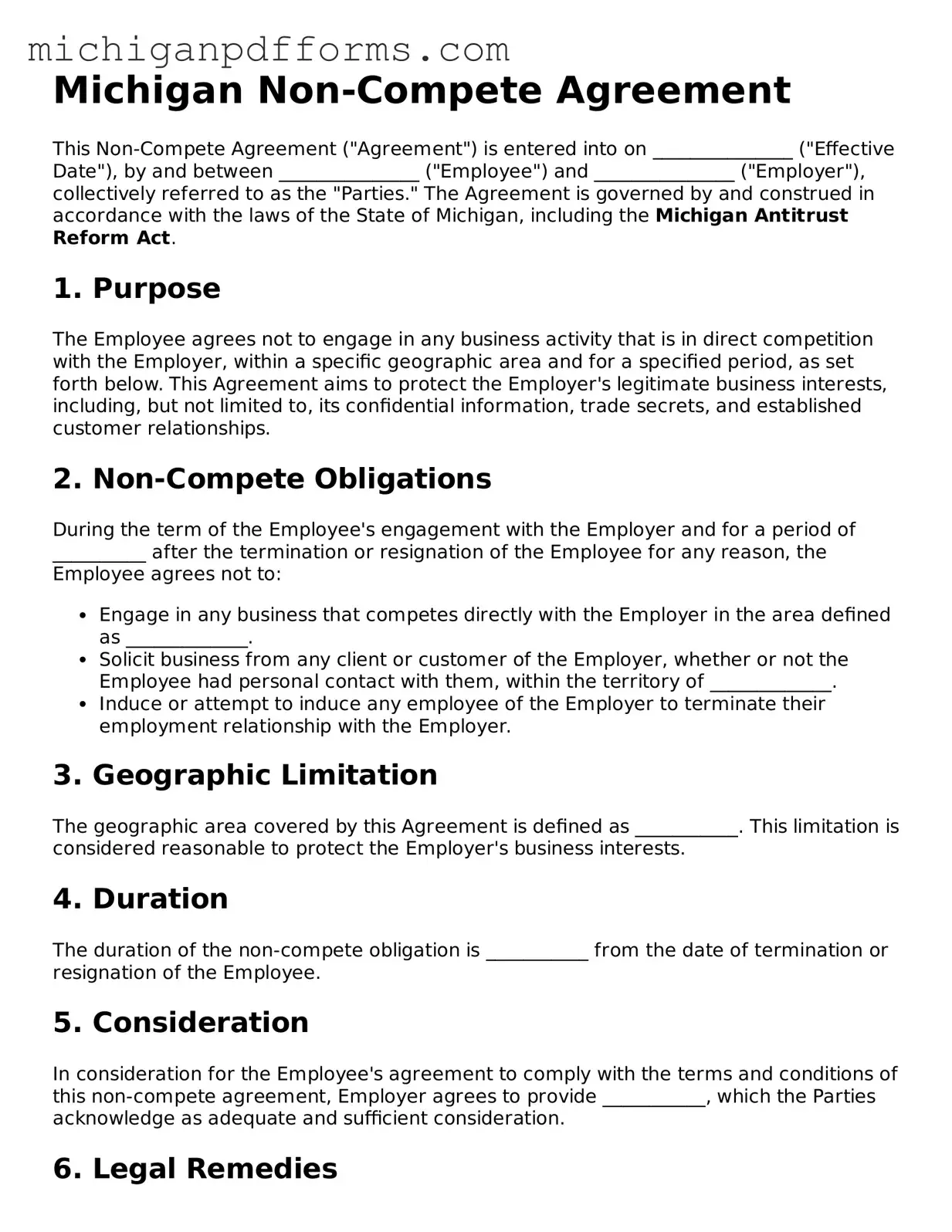
Blank Non-compete Agreement Form for Michigan State
The Michigan Non-compete Agreement form serves as a crucial document in the employment landscape, establishing the terms under which an employee agrees not to engage in competitive activities after leaving a company. This agreement typically outlines the duration of the non-compete period, the geographical scope of the restrictions, and the specific activities that are prohibited. Employers often use this form to protect their business interests, trade secrets, and client relationships from potential competition by former employees. While the enforceability of non-compete agreements can vary based on factors such as reasonableness and the nature of the industry, the Michigan form provides a structured approach to ensure that both parties understand their rights and obligations. It is essential for employees to carefully review the terms before signing, as the implications can significantly impact their future career opportunities. Understanding the nuances of this agreement is vital for both employers and employees navigating the complexities of employment law in Michigan.
Form Example
Michigan Non-Compete Agreement
This Non-Compete Agreement ("Agreement") is entered into on _______________ ("Effective Date"), by and between _______________ ("Employee") and _______________ ("Employer"), collectively referred to as the "Parties." The Agreement is governed by and construed in accordance with the laws of the State of Michigan, including the Michigan Antitrust Reform Act.
1. Purpose
The Employee agrees not to engage in any business activity that is in direct competition with the Employer, within a specific geographic area and for a specified period, as set forth below. This Agreement aims to protect the Employer's legitimate business interests, including, but not limited to, its confidential information, trade secrets, and established customer relationships.
2. Non-Compete Obligations
During the term of the Employee's engagement with the Employer and for a period of __________ after the termination or resignation of the Employee for any reason, the Employee agrees not to:
- Engage in any business that competes directly with the Employer in the area defined as _____________.
- Solicit business from any client or customer of the Employer, whether or not the Employee had personal contact with them, within the territory of _____________.
- Induce or attempt to induce any employee of the Employer to terminate their employment relationship with the Employer.
3. Geographic Limitation
The geographic area covered by this Agreement is defined as ___________. This limitation is considered reasonable to protect the Employer's business interests.
4. Duration
The duration of the non-compete obligation is ___________ from the date of termination or resignation of the Employee.
5. Consideration
In consideration for the Employee's agreement to comply with the terms and conditions of this non-compete agreement, Employer agrees to provide ___________, which the Parties acknowledge as adequate and sufficient consideration.
6. Legal Remedies
Violation of any provision of this Agreement by the Employee may cause the Employer irreparable harm. In such an event, the Employer is entitled to seek legal remedies, including but not limited to injunctive relief and damages.
7. Severability
If any provision of this Agreement is found to be invalid or unenforceable, the remaining provisions will continue in full force and effect. The Parties agree to replace any invalid or unenforceable provision with a valid one that most closely matches the intent of the original provision.
8. Entire Agreement
This Agreement constitutes the entire agreement between the Parties regarding the subject matter herein and supersedes all prior agreements and understandings, both written and oral, between the Parties.
IN WITNESS WHEREOF, the Parties have executed this Agreement as of the Effective Date first above written.
Employee: ________________________________________ Date: _______________
Employer: ________________________________________ Date: _______________
Document Properties
| Fact Name | Details |
|---|---|
| Definition | A non-compete agreement is a contract that restricts an employee from working for competitors after leaving a job. |
| Governing Law | The Michigan Non-Compete Agreement is governed by Michigan law, specifically the Michigan Compiled Laws. |
| Enforceability | Non-compete agreements are enforceable in Michigan, but they must be reasonable in scope and duration. |
| Duration | Agreements typically last for one to two years, but longer durations may be enforceable depending on circumstances. |
| Geographic Limitations | Restrictions must be limited to a reasonable geographic area where the employer operates. |
| Consideration | For a non-compete to be valid, there must be consideration, such as employment or promotion. |
| Exceptions | Certain professions, such as physicians, have specific regulations regarding non-compete agreements. |
| Judicial Review | Courts in Michigan will review non-compete agreements to ensure they do not impose undue hardship on employees. |
| Employee Rights | Employees have the right to challenge non-compete agreements if they believe the terms are unreasonable. |
| Modification | Non-compete agreements can be modified by mutual consent, but both parties must agree to the changes. |
Popular Michigan Templates
Simple Rental Application Form Pdf - Serves as a consent form for obtaining credit reports and background checks, aligned with privacy laws.
The Illinois Notice to Quit form plays a vital role in the eviction process, ensuring that tenants are adequately informed of their need to vacate the property; to facilitate this process, landlords can access the necessary documents through Illinois PDF Forms, which provide clear guidance on the proper procedures to follow.
Michigan Will Template Free - Enhances privacy by specifying how confidential matters should be handled, including personal letters or documents.
Purchase Agreement Michigan Template - It lays out the legal framework for transferring title, ensuring the buyer receives clear ownership free from undisclosed encumbrances.